Examines the process of decentralization during the 1996-97 school year across the Philadelphia School District as part of the Children Achieving Challenge. Principal research questions include: 1) How is Children Achieving strengthening schools’ capacity to make and carry out informed decisions that lead to schoolwide standards-based instructional reform? 2) How are the new structures at various levels of the system working? 3) In the context of a decentralizing system, how is the district resolving questions about what kind of guidance to provide schools? The authors provide an overview of the new school system in terms of administration, demographics, and performance statistics. The report also describes the current state of affairs across schools regarding issues such as school-based decision making, local school councils, and small learning communities. School clusters, developed around comprehensive high schools, have helped to achieve many of the decentralization goals outlined by Children Achieving but still need much improvement. Additionally, the Central Office of the District needs to reexamine its role in a decentralized school system. The report gives recommendations to help the District fully adapt to decentralization as part of a successful reform plan. Small learning communities are discussed in this report on pages 22-27. Also, the Children Achieving Theory of Change used clusters–constituted by a comprehensive neighborhood high school and its feeder middle and elementary schools. ‘Clusters are a key structural support in the Children Achieving theory of how to improve schools and student achievement’ (30). The report discusses how cluster staff viewed their roles (e.g. as brokers or as direct agents of change) (see pp.48-53). ‘During 1995-96 the Children Achieving Challenge focused on leadership development and changing the culture of the central office. Challenge staff said they also focused on curriculum and instruction during 1996-97’ (65). ‘The Children Achieving Challenge established seven Work Groups, each made up of school district personnel from the central office, clusters, the Philadelphia Federation of Teachers and, in some cses, schools and representatives from critical partners including Philadelphia Education Fund, universities, and city agencies’ (66).
Children Achieving: Guidance for School Improvement in a Decentralizing System: How Much, What Kind, and From Where?
Related Publications
Publication
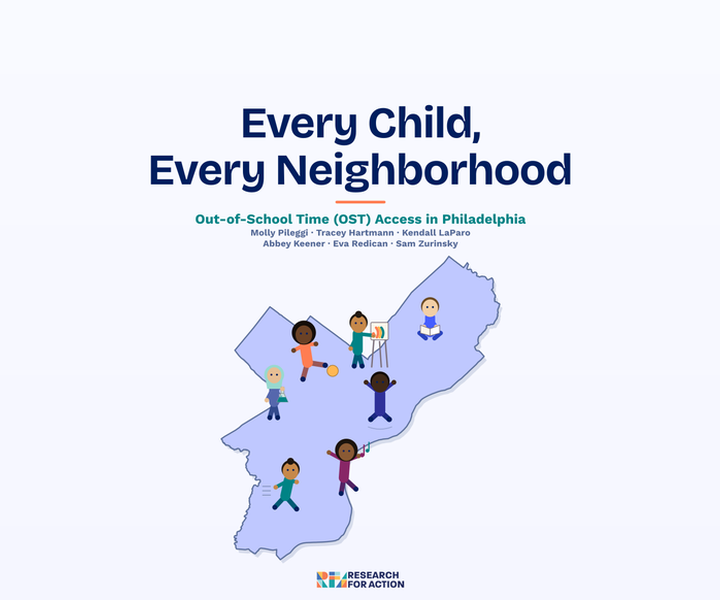
Executive Summary: Every Child, Every Neighborhood: Out-of-School Time Access in Philadelphia
An Overview Our new report, funded by the William Penn Foundation, offers the most complete picture yet of where OST programs exist for children from Pre-K through grade 8 in Philadelphia, where they fall short,…
Publication
Every Child, Every Neighborhood: Out-of-School Time Access in Philadelphia
An Overview Our new report, funded by the William Penn Foundation, offers the most complete picture yet of where OST programs exist for children from Pre-K through grade 8 in Philadelphia, where they fall short,…
Publication
Executive Summary: The Implementation, Impact, and Cost Effectiveness of Developmental Education Reform in California’s Community Colleges
Developmental education (DE) has come under increasing scrutiny as researchers have identified that a) many students placed in DE would be successful if placed in college-level coursework; b) lengthy DE course sequences lead to decreased…
Publication
Final Report: The Implementation, Impact, and Cost Effectiveness of Developmental Education Reform in California’s Community Colleges
Developmental education (DE) has come under increasing scrutiny as researchers have identified that a) many students placed in DE would be successful if placed in college-level coursework; b) lengthy DE course sequences lead to decreased…
Publication
Creating Safe Spaces: Promoting Physical and Emotional Safety
While multipurpose out-of-school time (OST) organizations provide supportive environments for youth development and social-emotional growth, in the context of the arts, safety requires an approach that mitigates physical harm and creates an emotionally safe space…
Publication
Building Bridges: Partnerships, Parents, and Pathways in Youth Arts
Multipurpose out-of-school time (OST) organizations partner with families to support children’s needs and gather input on programming. These organizations also collaborate with community groups to access resources, enrich content, and bolster sustainability. But because partnerships…
Publication
Moving Beyond Popsicle Sticks and Googly Eyes: How Current Art Equipment and Technology Can Improve Arts Programming
In many multipurpose out-of-school time (OST) organizations, “art” supplies are typically markers, construction paper, and glue with googly eyes, with popsicle sticks thrown in for fun. But while arts- and-crafts activities have their place, they…
Publication
Amplifying Youth Voice: Input, Leadership, and Agency in the Arts
While youth voice is important in arts-focused youth programming, many multipurpose out-of-school time (OST) organizations default to traditional crafts or adult‑designed projects. The result is limited opportunities for youth to make decisions, lead, or bring…
Publication
Unlevel Playing Fields: Disparities in Access and Investment in Pennsylvania High School Athletics
Access to high school athletics in Pennsylvania varies substantially by district. For many students, particularly those in large, urban districts, opportunities to participate in school-based sports remain limited or out of reach. This has meaningful…

Publication
Restorative Justice Practices in Allegheny County Schools: An Allegheny County Education Research Brief
In Allegheny County, schools are working to create safe, inclusive, and equitable learning environments, but disparities in discipline continue to affect students’ opportunities and experiences. Black students, particularly Black girls, remain disproportionately impacted by exclusionary…