
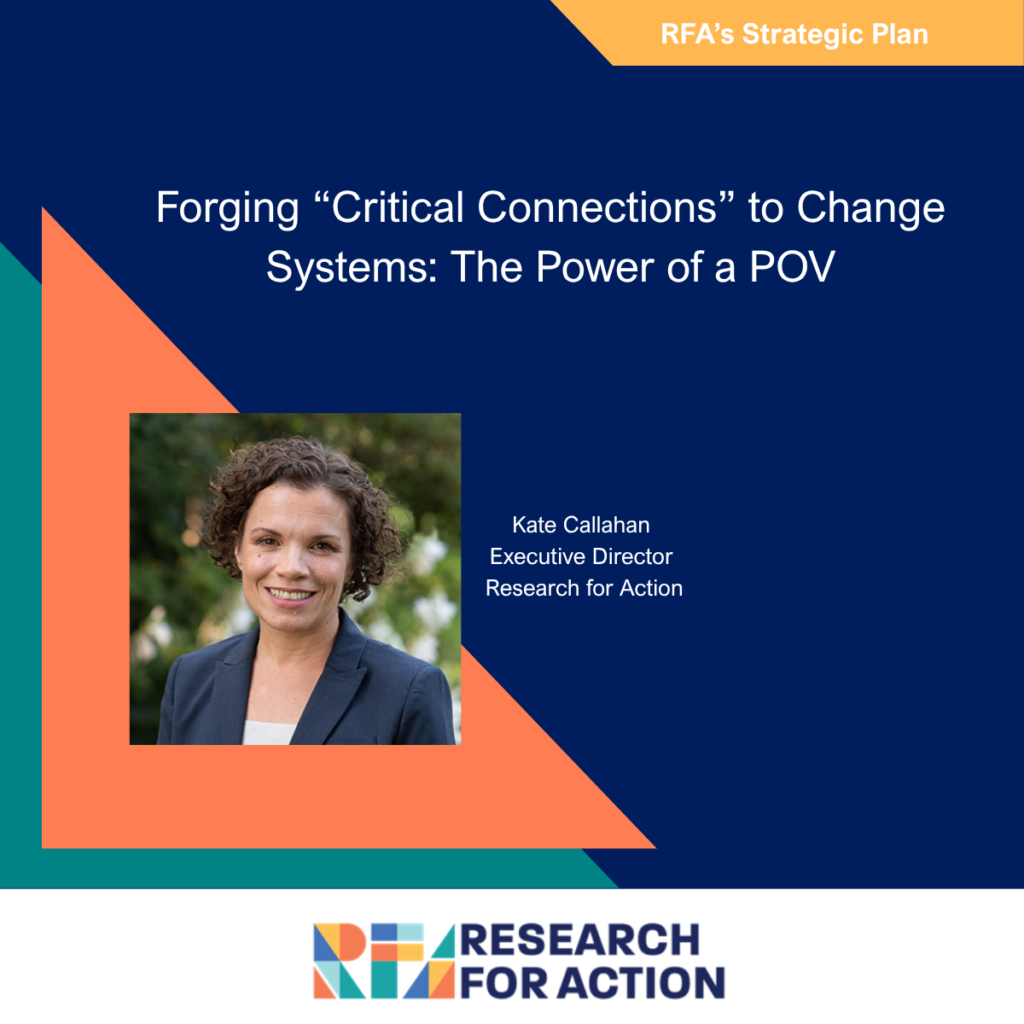
By Kate Callahan, Executive Director
“We never know how our small activities will affect others through the invisible fabric of our connectedness. In this exquisitely connected world, it’s never a question of ‘critical mass.’ It’s always about critical connections.” — Margaret J. Wheatley, Leadership and the New Science
I return to this quote often, as it captures something I’ve spent my career trying to articulate: that the work of changing education systems is not about scale. It’s about the quality of the relationships, the depth of the partnerships, and whether the people most affected by a system have genuine power in shaping it.
That conviction didn’t come from a book. It came from experience.
I started my career teaching in Philadelphia, and what I encountered stayed with me in ways no research study could have predicted. I watched parents arrive for teacher conferences carrying complicated relationships with school itself—returning to a building that had, for many of them, represented that they didn’t belong. I taught students who needed IEPs and 504 plans—supports I wasn’t permitted to name to their parents, because acknowledging the need meant the school was obligated to deliver services it couldn’t. And I taught students who might have thrived with more academic challenge, but who couldn’t access the district’s special admission schools because there was no school psychologist to shepherd their applications. Very different needs. The same structural abandonment.
I went on to pursue a Ph.D. in urban education, but graduate school taught me a different kind of lesson. Studying university-community partnerships, I watched well-resourced institutions arrive in neighborhoods with answers already in hand. Reforms came and went. Some generated real momentum, but were replaced by the next initiative before anything took root. What united the failures was a common flaw: things were being done to or for communities rather than with them.
That insight followed me to Research for Action, where I’ve spent the past 16 years, the last five as Executive Director. And that insight has sharpened into something I now consider RFA’s point of view: that transformative research requires braiding methodological expertise with lived experience, and making what we’ve learned available to those in a position to change policies or systems.
A project in New Hampshire, which I led early in my time at RFA, is one illustration of this POV. New Hampshire had made a bold policy shift, moving from seat-time requirements to a competency-based education system and wanted to understand how the shift was playing out across the state. Rather than arriving with a pre-built measurement framework, we developed the data set in collaboration with the state’s Department of Education and all 22 high schools implementing extended learning opportunities (ELO). Our state partnership ran deep—and included the Deputy Commissioner’s office, the data management bureau, and the ELO Coordinators Group, who invited us to present our progress at their monthly meetings and offered feedback on our conceptual framework. Practitioners were shaping the research, not just participating in it, and were benefiting from the knowledge that we collectively uncovered.
A more recent project shows how that participatory model has deepened. RFA’s research on California’s developmental education reforms, Assembly Bills 705 and 1705, required us to understand not just state policy, but its impact on community colleges with very different local contexts. Building those relationships opened a door we hadn’t anticipated: community college faculty working with incarcerated students began raising questions that existing research wasn’t asking: Were the same reforms reaching students pursuing higher education from prison? Were they experiencing the same benefits as their peers on the outside? With support from Ascendium Education Philanthropy, RFA is now pursuing those questions—centering the experiences of incarcerated learners, faculty, and administrators to generate insights that policymakers and advocates can actually use. The research question didn’t originate in our office, but from the people closest to the problem.
Closer to home, the Democratizing Education Data Collective reflects the most direct expression of what we mean by redistribution of power. In Philadelphia—the city where RFA was founded and where our roots run deepest—we are convening parents, community members, and other stakeholders to engage in something research organizations rarely invite: to commission, shape, and use data themselves. RFA serves as facilitator, convener, data literacy trainer, and technical assistance provider. We are not the lead researchers. That role belongs to the community. The central question driving this work is whether community researchers shaping their own research questions and priorities will lead to more just and effective educational systems. We believe the answer is yes. But more importantly, we believe that question should never have been ours alone to ask.
These projects represent the range of how RFA lives its POV. Depending on what a community or system needs most, our role shifts. Sometimes we are the research partner. Sometimes we follow where practitioners lead. Sometimes we hand over all the tools. What doesn’t change is the orientation: research done with and for communities—with an emphasis on directly applying the learnings—in service of systems change.
I began with Margaret Wheatley’s observation that change is never about critical mass— it’s about critical connections. That’s what RFA’s strategic plan is built upon: a conviction that the right partnerships, at the right depth, with the right communities and change agents, are what actually move systems. The plan also acknowledges our emerging capacity to serve as a strategy and learning partner for funders and system leaders navigating complexity and uncertainty.
In the posts that follow, I’ll go deeper into each of the four pillars of RFA’s strategic plan—transforming research practice, partnering with change agents, operating as a human-centered organization, and building long-term organizational sustainability. Each post will bring that pillar to life through the work, partnerships, and lessons we’re still learning.
If what you’ve read here resonates—whether you’re a funder, a practitioner, a policymaker, or a fellow researcher wrestling with similar questions—I welcome the conversation. You can explore our full portfolio of work at researchforaction.org, or reach out to me directly. The connections that matter most rarely happen at scale. They start with one conversation.